Productos
Software de Mapas Mentales
Software de Esquemas
Software de Diagramas de Gantt en línea
Usos
Mapas Mentales para la Educación
Mapas mentales para Empresas
Mapas Mentales para el Desarrollo Personal
Beneficios de los Mapas Mentales
Recursos
Características
Educación
Personal & Trabajo
Desktop
Tutoriales en vídeo
Vea consejos y trucos sobre el uso de Mindomo.
Centro de ayuda
Guía de ayuda detallada sobre la configuración y el uso de Mindomo.
Artículos
¿Qué es un mapa mental?
¿Cómo hacer un Mapa Mental?
How to Take Notes with Mind Maps?
How to Prioritize Tasks with Mind Maps?
¿Qué es un mapa conceptual?
Los 29 mejores ejemplos de mapas mentales
Precios
Iniciar sesión
Registrarse
Productos
Software de Mapas Mentales
Software de Esquemas
Software de Diagramas de Gantt en línea
Usos
Mapas Mentales para la Educación
Mapas mentales para Empresas
Mapas Mentales para el Desarrollo Personal
Beneficios de los Mapas Mentales
Artículos
¿Qué es un mapa mental?
¿Cómo hacer un Mapa Mental?
How to Take Notes with Mind Maps?
How to Prioritize Tasks with Mind Maps?
¿Qué es un mapa conceptual?
Los 29 mejores ejemplos de mapas mentales
Características
Educación
Personal & Trabajo
Desktop
Ayuda
Tutoriales en vídeo
Centro de ayuda
Precios
Registrarse
Iniciar sesión
Categorías:
Todo
-
contributions
-
sources
-
perspectives
-
timeline
por
Hector Trejo
hace 6 años
264
htrejoma@g.emporia.edu
Abrir
Ver más
Blood Diamonds 2
por Montalbo Lance
Social Studies Mind Map
por Brian Tate
frazioni quotidiane
por Carolina Jimenez
Social Studies Mind Map
por Brian Tate
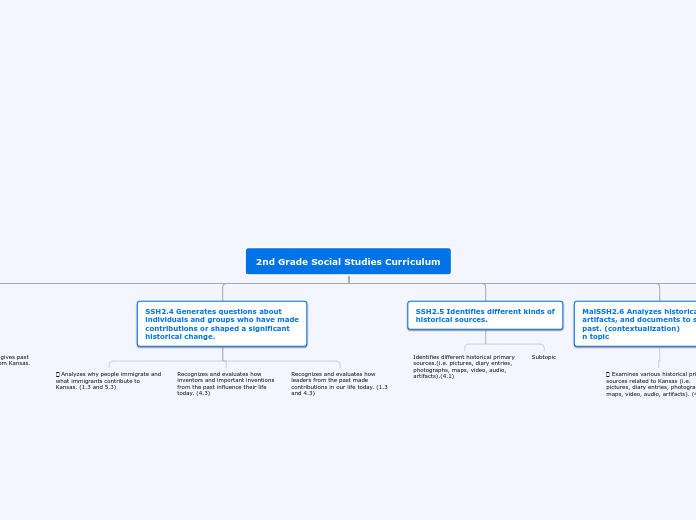
2nd Grade Social Studies Curriculum
SSH2.10 Compares perspectives of people in the past to those of people in the present
Develops an understanding of how perspectives have changed from the past to the present (i.e. women’s rights). (3.3)
SSH2.9 Compares different accounts of the same historical event.
Understands that people writing accounts of the past today write them from their own perspective. (3.2)
Understands that different people living at the same time in the past had different beliefs and ideas that shaped their accounts of events. (3.2)
SSH2.8 Identifies the maker, date, and place of origin for a historical source. (sourcing
Looks for clues that identify the maker, date, and place of origin for a historical source.(4.1)
SSH2.7 Generates possible reasons for an event or development in the past.
Looks at an event from the past and traces the cause(s) of the event. (4.2)
MaiSSH2.6 Analyzes historical sources, artifacts, and documents to study the past. (contextualization) n topic
Examines various historical primary sources related to Kansas (i.e. pictures, diary entries, photographs, maps, video, audio, artifacts). (4.1)
SSH2.5 Identifies different kinds of historical sources.
Identifies different historical primary sources.(i.e. pictures, diary entries, photographs, maps, video, audio, artifacts).(4.1)
SSH2.4 Generates questions about individuals and groups who have made contributions or shaped a significant historical change.
Recognizes and evaluates how leaders from the past made contributions in our life today. (1.3 and 4.3)
Recognizes and evaluates how inventors and important inventions from the past influence their life today. (4.3)
Analyzes why people immigrate and what immigrants contribute to Kansas. (1.3 and 5.3)
SSH2.3 Compares life in the past to life today.
Defines immigration and gives past and present examples from Kansas. (5.3)
Compares American Indian life and communities at the time of the Pilgrims to American Indian life and communities today. (3.3 and 4.3)
Compares and contrasts the ways people communicate with each other past and present. (4.3)
Subtopic
Compares various forms of transportation in Kansas and present. (4.3)
SSH2.2 Sequences historical events on a timeline.
Creates and uses a timeline of events in Kansas over the course of the school year. (4.4)
SSH2.1 Defines history as the story of the past.
Defines the difference between past and present. (4.1)
Describes history as the story of the past.(4.1)