Human beings often wrestle with the quest for life's meaning amidst a seemingly chaotic and indifferent universe. Absurdism posits that life lacks inherent meaning, and individuals exist in a purposeless world.
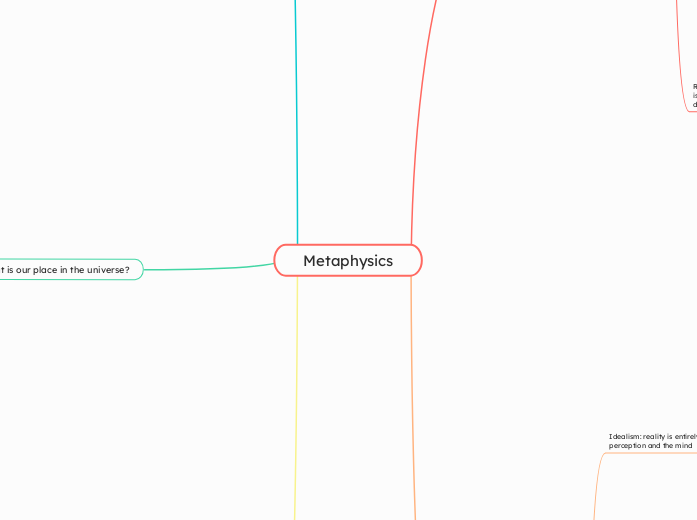
Metaphysics
What is consciousness?
Experientialism: consciousness defined by subjective, experiential perception (qualia)
Nagel, in his influential essay "What Is It Like to Be a Bat?", argues that consciousness involves and irreducible subjective quality. He emphasizes that scientific descriptions cannot fully capture how it feels, internally and subjectivel, to experience the world from another creature's perspective, such as a bat's echolocation. This clearly demonstrates experientialism by highlighting that consciousness in inherestenyl to an individual's internal, personal viewpoint rather than it being purely objective, as an external observation.
Thomas Nagel
Materialism (Physicalism): consciousness is solely the product of physical processes in the brain
Neuroscience studies showing brain scans directly correlate to conscious experiences, demonstrating the dependance of consciousness and personality on physical brain function.
Daniel Dennett, Patricia Churchland
Dualism: mind and body are separate entities; consciousness exists independently from physical matter
Documented reports of Out-Of-Body Experiences (OBEs), highlighting experiences of consciousness functioning independently from physical senses. These medical researches into near-death experiences, where individuals report conscious experiences despite clinical brain inactivity, strongly suggesting mind-body separation.
René Descartes
What is our place in the universe?
Cosmic Insignificance: humanity holds no special place within the vast, indifferent universe
Documentaries and psychological factors and scientific discoveries contributing to this perspective, such as the "Pale Blue Dot" Nasa image which demonstrates Earth's smallness, or Carl Sagan's "Cosmos" which highlights humanity's small role within the expansive universe.
Carl Sagan
Holism: humans are fundamentally interconnected parts within a broader universe or ecological system
Indigenous teachings on interconnectedness with nature and their perspectives on holism, often called "wholistic" in indigenous contexts emphasize the physical, emotional, spiritual, and intellectual within a larger network of relationships with land. community, and the cosmos.
Lao Tzu (taoism)
Anthropocentrism: belief that humans are the most significant beings in the universe
Historical and Judeo-Christian teachings on humanity's dominion over nature has been prevalent, it is a basic belief embedded in many western religions and philosophies. regarding humans as separate from and superior to natural while other entities are resources that may be justified for exploitation.
Do we have free will?
Libertianism: humans have complete freedom of choice
Entrepreneurs making bold personal choices and taking risks independently, demonstrating belief in autonomous free will, as exemplified by Elon Musk's motives and choices as he ventures with Tesla, SpaceX and DOGE
Philosopher: Jean Paul Sartre
Compatibilism: free will exists along determinism; they coexist
Judicial systems recognize external influences on behaviour but still hold individuals morally accountable for their actions (view on crime and punishment)
David Hume
Determinism: choices influenced by prior events or causes. In Christianity, determinism manifests are the view that God determines all events and individual destinies
In Christianity, it is believed that the view that god determines every event that occurs in the history of the world. Some of these prominent determinists include figures like St. Augustine.
Baruch Spinoza, B.F. Skinner, St Augustine
Does the world really exist?
Realism: the external world exists independently of perception
With scientific and technological advances, such as space exploration and medical developments, strongly demonstrates realism. Organizations like NASA consistently rely on the predictability of natural laws, such as gravity, orbital mechanics, and physics, to plan space missions and develop technologies. The fact that spacecraft creations, medical treatments, and engineered structures function reliable and repeatedly across countless experiments confirms the existence of stable natural laws and an objective external reality indepet of individual human perceptions.
Aristotle
Solipsism: only one's mind is to certain to exist the external world might be illusory
Dream experiences strongly illustrate solipsism. When dreaming, individuals perceive events, people, and environments that feel entirely real. However upon waking, it's clean there were only mental constructions, existing only within their minds. Solipsism applies this logic to reality itself, suggesting waking experiences could similarly be personal mental fabrications, indistinguishable from vivid dreams. This philosophical stance challenges our certainty regarding external reality, highlighting the subjective nature of our perception and consciousness.
Gorgias
Idealism: reality is entirely constructed by perception and the mind
The iconic film "The Matrix" illustrates idealism through a narrative where human beings live unknowingly in a simulated reality, their experiences entirely dependant on perception manipulated by an external system. Characters in the film grapple with the fundamental question of what is truly real, eventually recognizing that their percieved reality is merely an elaborate illusion generated by their minds through external simulation. This cinematic scenatio aligns closely with Berkeley's idealist philosphy, reinforicng the notion that reality, as expereinced, fundamentally depends upon perception rather than objective external existence.
George Berkeley
What is the meaning of life?
Religious Spirituality: the belief that life's meaning is derived from connection or devotion to a higher divine purpose or religious tradition
Across diverse religious traditions worldwide such as Christianity, Islam, Judaism, Hinduism, and Buddhism, individuals find profound meaning through spiritual practices including prayer, meditation, and communal worship. These traditions commonly teach that life's ultimate purpose is serving, understating , or uniting with a divine power or spiritual truth, providing followers a clear sense of purpose and direction. Studies and surveys consistency highlight how spiritualty significantly contributes to believer's sense of meaning, mental well-being, resilience, and satisfaction with life, reinforcing the powerful role religious spirituality plays in defining human existence.
Thomas Aquinas, Augustine of Hippo
Absurdism: that human beings exist in a purposeless, chaotic universe. While life itself lacks inherent meaning and the universe is indifferent to human struggles. Yet, individuals should defiantly seek personal meaning despite the absurdity of existence
Franz Kafka's literary works, particularly "The Metamorphosis" portrays absburism by illustrating characters trapped in surreal, irrational, and meaningless situations. In Kafka's story, Gregor Samsa inexplicably awakens one morning transformed into a giant insect, a scenario highlighting life's absurd cruelty and existential absurdity. Kafka exquisitely depicts individuals struggling against an indifferent, nonsensical world, mirroring Camus's philosophical stance that despite life's inherent absurdist, humans persistently will seek understanding, meaning and purpose.
Albert Camus
Existentialism: Meaning created individually, and is not given universally
Sartre's concept of "authentic living" emphasizes personal freedom, responsibility, and integrity. According to Sartre, authenticity involves consciously rejecting societal expectations or external pressures and actively choosing a life aligns with one's own genuine values and beliefs. This philosophy profoundly influences modern self0help and personal growth movements, where authors and speakers encourage individuals to live purposefully, reject conformity, and embrace genuine self-expression to achieve personal fulfillment and meaning of life.