MTE 280
Wk 11: adding, subtracting, multiplying, & dividing Fractions
1/6 + 2/6 = 3/6
same denominator - you add only the pieces (numerator)
6/12 - 1/12 = 5/12
2/3 + 4/5---> find common denominator
10/15 + 12/15 = 22/15-- improper fraction --> 1 7/15
3 x 2/2 = 6/2 + 1/2 = 7/2
Dividing fractions
Wk 10: Fractions
What is a fraction-? A way of expressing a relationship between a part and a whole
Meanings of Fractions- part/whole - Quotient - Ratio
A Ratio part to part & part to whole is ration and fraction
Ex) 3/7 or 1/7
3/7 because there are more parts of the same whole (same size pieces)
Wk 8: Prime Factorization
24: 1,2,3,4,6,8,12,24
prime tree of 24< 4 &6
2 ^2 3 ^2
Express Product this way ONLY --> 24= 2x2x2x3
Need to know Prime numbers for --> GCF & LCM
GCF- Greatest common factor --> #s when multiple together (used when simplify fraction)
LCM- Least common multiple--> skip counting
List Method
GCF- 24: 1,2,3,4,6,8,12,24
36: 1,2,3,4,6,9,12,18,36 // GCF (24,36) =12
LCM- 24: 24,48,72,96
36: 36,72 // LCM (24,36) =72
Prime factorization
*This strategy needs both GCF & LCM
24= 2x2x2x3
36= 2x2x3x3
look for common pairs
Wk 7: Number Theory
Subtopic
Factors
factors of 28: 1,28,2,14,4,7
42: 1,42,2,21,3,14,6,7
List of Factors
20: 1,2,4,5,10,20
39: 1,39,3,13
91: 1,91,7,13
Divisibility Rules
-ending// By 2: 0,2,4,6,8 By 5: 0,5 By 10: 0 Ex) 24 is divisible by 2 because it ends in 4. 12,070 divisible by 2 because it ends with 0
Sum of Digits
by 3: if sum of Digits is divisible by 3
by 9: if sum of digits is divisible by 9
by 6: if its divisible by BOTH 2 &3
Last Digits
by 4: if last 2 digits are divisible by 4
by 8: if last 3 digits are divisible by 8
by 7: double last digit, subtract from remaining number , repeat
by 11: the "chop off" method, chop off last 2 digits, add them to remaining number, repeat
Numbers that go into another numbers without remainders - A is divisible by B if there is a number C that meets the requirement--> C x B = A Ex) 10 is divisible by 5 because there is a number, 2. that meets the requirements
Fractions involve: types of #, divisibility rules, factors and multiple of #s
Wk 5: Addition/subtraction/multiplication Algorithms
Addition Algorithms:
American Standard- (last step)
576 R to L
+279
855
Partial Sum-
576 R to L
+279
15
+ 1 4
7
855
With Place Value-
576
+ 279
15
+ 140
700
855
Left to Right-
576
+ 279
700
+ 140
15
855
Expanded Notation-
100 10
576 = 500 + 70 + 6
+279 = 200 + 70 + 9
855 = 800 + 50 + 5 *start with this algorithm then when understood-- American standard. *
Lattice Methods-
shown in video
Subtraction Algorithms:
American Standard-
576 R to L w/ no reference to place value
- 289
287
Reverse Indian-
17 16
576 L to R
- 289
3
2
9
8 7
287
Left to Right- (added place value)
170 16
576
- 289
300
200
90
80
7
287
Expanded Notation:
400 160 16
576 = 500+70+6
- 289= 200+80+9
287= 200+80+7
Integer Sub. Algor. -
576
- 289
-3
-10
+300
287
Multiplication Algorithms:
American Standard-
23
x 14
192
+ 230
322
Place Value-
23 --> 4x3= 12
x 14 4x20=80 *add all products
10x3=30
10x20=200
322
Expanded Notation-
23 Take 23, 14 times or 14 groups of 23
x 14 10
20+3
x 10+4
100 90+ 2 --> comes from taking 23, 4 times
200+ 30+0
300+ 20+2 = 322
Lattice method-
shown in video
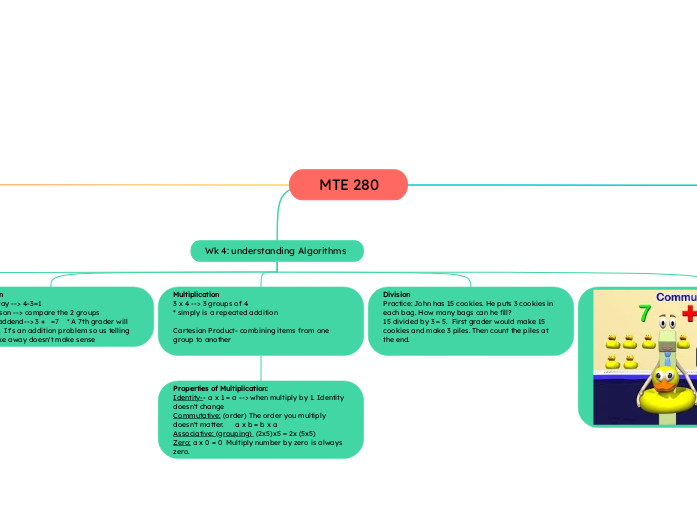
Wk 4: understanding Algorithms
Division
Practice: John has 15 cookies. He puts 3 cookies in each bag. How many bags can he fill?
15 divided by 3 = 5. First grader would make 15 cookies and make 3 piles. Then count the piles at the end.
Multiplication
3 x 4 --> 3 groups of 4
* simply is a repeated addition
Cartesian Product- combining items from one group to another
Properties of Multiplication:
Identity-- a x 1 = a --> when multiply by 1. Identity doesn't change
Commutative: (order) The order you multiply doesn't matter. a x b = b x a
Associative: (grouping) (2x5)x5 = 2x (5x5)
Zero: a x 0 = 0 Multiply number by zero is always zero.
Subtraction
1. takes away --> 4-3=1
2. comparison --> compare the 2 groups
3. Missing addend--> 3 + =7 * A 7th grader will add until 7. It's an addition problem so us telling them to take away doesn't make sense
Addition meaning & properties: Putting together; Joining
Identity-- a + 0 = a *when I add zero to a number the identity doesn't change*
Commutative-- (order property) a+b= b+a *the order of numbers doesn't matter*
Associative--(grouping) (a+b)+c= a+(b+c) *the grouping of numbers doesn't matter*
Wk 3: Bases
Ex.) base 9
12= 13(9)
(* * * * * * * * *) * * *
1 group of 9 and 3 left over
base 8
12= 14 (8)
(* * * * * * * *) * * * *
1 group of 8 and 4 left over
Base 3: Digits 0,1,2
ones--> 3^0
threes--> 3^1
nines--> 3^2
27s--> 3^3
1222(3)= (1x3^3) + (2x3^3) + (2x3^1) + (2x3^0)
27 + 18 + 6 + 2 = 53
Base 5
ones-> 5^0
fives-> 5^1
25s->5^2
125s->5^3
Digitis used: Base-5
0,1,2,3,4
Wk 2: Numeration Systems
Base 10
one -> 10^0
tens-> 10^1
hundreds-> 10^2
thousands-> 10^3
Expanded Notation:
375= 300+70+5
= (3x100) + (7x10) + (5x1)
= (3x10^2) + (7x10^1) + (5x10^0)
1,078= 1,000+0+70+8
= (1x1000)+ (0x100) + (7x10) + (8x1)
= (1x10^3) + (0x10^2) + (7x10^1) + (8x10^0)
Digits used: base-10
0,1,2,3,4,5,6,7,8,9
A way of recording quantity (place value)
- a base-10 system also a positional system (place where they sit)
Ex.) 33,333
^^, ^^^
10-thousand thousand, hundreds tens ones
375.25
^^^.^^
hundreds tens ones . tenths hundredths
Wk 1: Problem Solving
Ex) 7 people in room, everyone needs to shake hands with only 1 person
1> 2,3,4,5,6 (6 people)
2>3,4,5,6,7 (5 people)
3> 4,5,6,7 (4 people)
4> 5,6,7 (3 people)
5> 6,7 (2 people)
6> 7 ( 1 person)
= 21 Handshakes
Polya's 4 steps to problem solving
1. Understand the problem (what am I looking for?)
2. Devise a plan *strategy* (picture, trail &error)
3. Carry out the plan- time to figure out own strategy (use manipulatives)
4. Look Back- check your work and see if the answer is reasonable