Categorii: Tot

realizată de Ashly Margarette Sunico 8 luni în urmă

9

METAPHYSICS

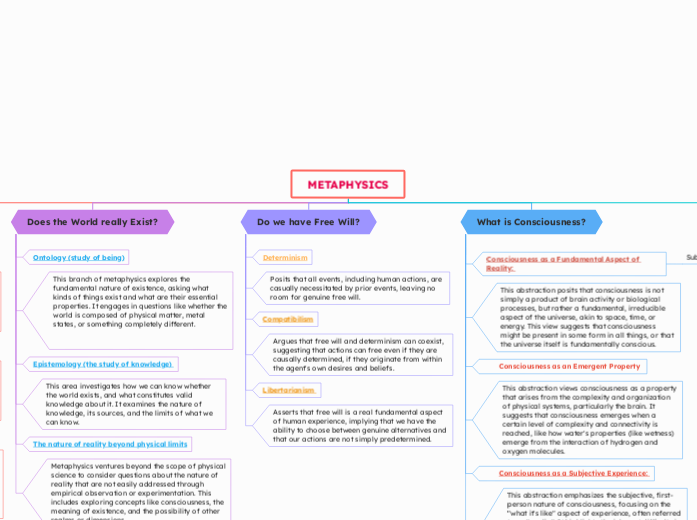
Metaphysics explores concepts beyond physical science, delving into the nature of reality, existence, and consciousness. It includes ontology, which examines what kinds of things exist and their essential properties, and epistemology, which investigates how we know the world exists and the sources of knowledge.
METAPHYSICS

METAPHYSICS

Main Does any of this – even my act of questioning – actually matter?

This abstraction acknowledges that even in a seemingly meaningless universe, we have the capacity to create our own meaning and purpose. Our choices, actions, and relationships can shape our experiences and give them significance, even if that significance is entirely self-defined.
The Potential for Meaning Creation
This abstraction emphasizes that our perception of reality and the "meaning" we ascribe to it are entirely subjective and personal. What one person considers meaningful, another may find meaningless, and there is no objective standard by which to judge the value of existence or our actions.
The Subjective Nature of Experience
This abstraction posits that the universe, and our place within it, is fundamentally devoid of pre-ordained meaning or purpose. Our existence, and even our actions and thoughts, are simply events in a vast, indifferent cosmos, and there is no inherent value or significance to be found.
The Inherent Meaninglessness of Existence

What is Consciousness?

This abstraction emphasizes the subjective, first-person nature of consciousness, focusing on the "what it's like" aspect of experience, often referred to as "qualia". It highlights the inherent difficulty in understanding consciousness from a purely objective, third-person perspective, as the subjective nature of experience is inaccessible to those who do not share it. This view suggests that even the most advanced scientific understanding of the brain might not fully explain the nature of subjective experience.
Consciousness as a Subjective Experience:
This abstraction views consciousness as a property that arises from the complexity and organization of physical systems, particularly the brain. It suggests that consciousness emerges when a certain level of complexity and connectivity is reached, like how water's properties (like wetness) emerge from the interaction of hydrogen and oxygen molecules.
Consciousness as an Emergent Property
This abstraction posits that consciousness is not simply a product of brain activity or biological processes, but rather a fundamental, irreducible aspect of the universe, akin to space, time, or energy. This view suggests that consciousness might be present in some form in all things, or that the universe itself is fundamentally conscious.
Consciousness as a Fundamental Aspect of Reality:
Subtopic

Do we have Free Will?

Asserts that free will is a real fundamental aspect of human experience, implying that we have the ability to choose between genuine alternatives and that our actions are not simply predetermined.
Libertarianism
Argues that free will and determinism can coexist, suggesting that actions can free even if they are causally determined, if they originate from within the agent's own desires and beliefs.
Compatibilism
Posits that all events, including human actions, are casually necessitated by prior events, leaving no room for genuine free will.
Determinism

Does the World really Exist?

Metaphysics ventures beyond the scope of physical science to consider questions about the nature of reality that are not easily addressed through empirical observation or experimentation. This includes exploring concepts like consciousness, the meaning of existence, and the possibility of other realms or dimensions.
The nature of reality beyond physical limits
This area investigates how we can know whether the world exists, and what constitutes valid knowledge about it. It examines the nature of knowledge, its sources, and the limits of what we can know.
Epistemology (the study of knowledge)
This branch of metaphysics explores the fundamental nature of existence, asking what kinds of things exist and what are their essential properties. It engages in questions like whether the world is composed of physical matter, metal states, or something completely different.
Ontology (study of being)

What is the meaning of life?

This abstraction examines whether the meaning of life is something that can be discovered objectively, perhaps through scientific or philosophical inquiry, or if it is a matter of personal interpretation and experience. Do certain actions or experience inherently hold meaning or is meaning something we create for ourselves.
Objective vs, Subjective Meaning
This explores the question of whether we have genuine free will to make choices, or if our actions are predetermined by factors beyond our control. If determinism is true, does it negate the possibility of meaning or purpose, or can we still find meaning within a predetermined framework?
Free will vs. Determinism
This abstraction delves into questions about what it means to exist, both as individuals and as species, and how consciousness arises and functions. Is our existence a random occurrence in a vast, indifferent universe, or is there deeper purpose or meaning inherent in our being?
Existence and Consciousness